
Disgrace. Shame. Mistrust. These are words that go hand in hand with stigma. And even though scientific research has shown otherwise, mental illness and addiction are still seen by many through a distorted lens as forms of indulgence, or weakness, or flaws in a person's character
Together we can reduce stigma and create positive change.
Among the many heartbreaking outcomes of stigma are silence and isolation. The result is that people in great pain remain quiet for fear of being judged. As their isolation grows, the people in their lives become less willing to ask what's wrong.
The cycle perpetuates itself mainly because it prevents people from doing the one thing that will help the most: seek treatment.
Mental illness and addiction are real medical illnesses, just like heart disease, cancer, or diabetes.
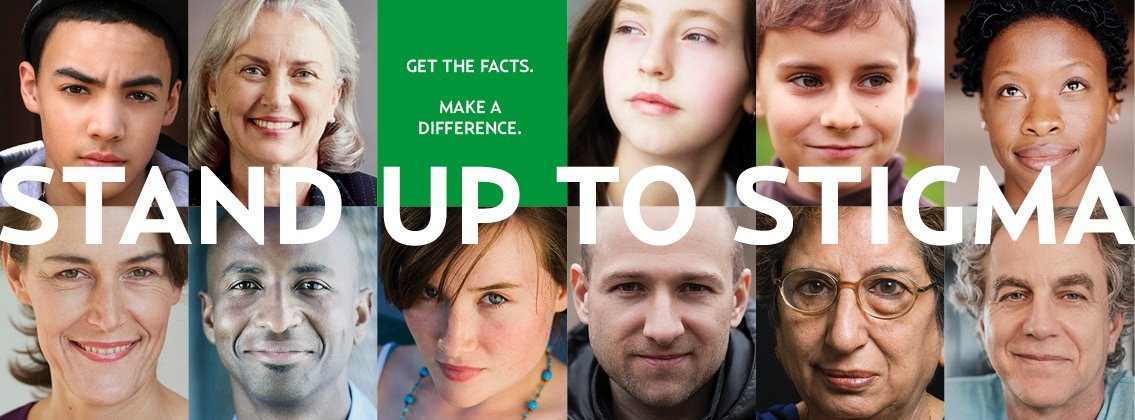

The goals of the Stand Up to Stigma public awareness campaign are to:
- Educate the public about the realities of mental health problems and addiction.
- Offer steps we can all take to help reduce stigma.
- Encourage people who need help to seek it without shame or fear.
- Help increase empathy and understanding in our communities.
Don't people with mental health problems tend to be violent?
People will mental health problems are no more likely to act violently than anyone else in society. Only 3-5 percent of all violent acts can be attributed to people living with a serious mental illness. On the flip side, people with severe mental illness are more than 10 times more likely to be victims of violent crime than the general population.
Isn't mental illness fairly rare?
Actually, it's fairly common. According to government statistics, one in five adults experiences mental illness, and about one in ten young people experiences a period of major depression (mentalhealth.gov, 2014).
Are psychiatric disorders really "true" medical illnesses like diabetes and heart disease?
They are. Psychiatric illnesses are the result of problems with the functioning of the brain. These problems often have genetic, environmental and biological causes. And they can be treated effectively!
Can't people who are depressed just snap out of it if they try hard enough?
Depression has nothing to do with a person's character or willpower. It's the result of changes in the chemistry and function of the brain. Fortunately, medication and/or psychotherapy help most people recover from depression.
Do people really recover from mental illness?
Yes. With the proper treatment, most people who suffer from a mental illness recover and go on to lead productive, rewarding lives that include work, family, and community activities.
Add your voice to help shift attitudes toward a more respectful, informed, and compassionate way of thinking about mental health and addiction.
Get the facts.
Stigmas about mental illness and addiction are often based on myths. Studies show that many people who experience these problems are productive members of society who can benefit from treatment.
Choose your words well.
Words matter.
Think about the terms you use to describe people who experience mental health problems or addictions. Never reduce people to a diagnosis. Engage in respectful dialogue with others who may use hurtful language.
Use your influence.
We’re all connected to one another. Be a voice for fairness and truth with your friends, family members, and the young
people in your life.
Share how you help increase awareness and understanding of mental illness and addiction. And remember to:
- Be inclusive.
- Check your own attitudes.
- Practice empathy.
- Offer your support.
- Be positive.
- Share the truth.
- Challenge media stereotypes.
Mental illness and addiction are real medical illnesses, just like heart disease, cancer, or diabetes. We believe that through education, empathy, and encouragement, people with mental illness and addiction can get the help they need and stand as equals in our society.
Get involved.
Engage with the people in your life and your community. Consider joining a peer support group or campaign that provides a safe platform to talk about how mental illness and addiction stigmas have affected you or someone you care about.
- The National Alliance on Mental Illness (NAMI) offers a range of peer-directed programs providing education and support.
- Alcoholics Anonymous (AA) is a nonprofessional, self-supporting, multiracial, apolitical fellowship of men and women who have had a drinking problem. AA meetings are available almost everywhere.
- Narcotics Anonymous offers peer support for individuals who have struggledwith addiction.
- Nar-Anon Family Groups offer 12-step programs for families and friends of people who suffer from addiction.
- Al-Anon Family Support Groups are peer-led groups that offer support and understanding to friends and family of problem drinkers.
- ActiveMinds is a leading nonprofit organization that empowers students to speak openly about mental health in order to educate others and encourage help-seeking.
Resources:
Vermont Department of Mental Health: Find mental health services in your area
U Matter U Can Get Help provides resources and information related to youth suicide prevention.
Mantherapy.org, an interactive online mental health campaign targeting working age men (25-54) that employs humor to cut through stigma and tackle issues including depression and anxiety.
National Alliance on Mental Illness (NAMI), the nation’s largest grassroots mental health organization dedicated to building better lives for the millions of Americans affected by mental illness.
National Suicide Prevention Lifeline - 1-800--273-8255
The Vermont Suicide Prevention Center is dedicated to ensuring that people of all ages have the knowledge, attitudes, skills, and resources to reduce the risk of suicide.
Vermont 2-1-1 Get Connected. Get Answers.
Social Media:
Follow us in social media to see updates, photos, and videos related to the Stand Up to Stigma campaign and other initiatives aimed at raising awareness around mental health.